
The organizational habits a child develops in third grade are still shaping how they manage their workload in eleventh grade.
Organization is not a trait some students have and others don’t. It is a skill built gradually, reinforced by the right tools, and made automatic by consistent practice. This guide shows you how to build a student organization system that grows with your child from kindergarten all the way through senior year.
A system is a set of connected structures that work together automatically. It’s not “remember to put your homework in the right folder.” It’s a setup where there is only one possible right place for the homework, the folder is always the same color, and the color is always the same subject so the brain doesn’t have to make a decision at all.
Organization is a prerequisite for success. Organization crosses all studies for higher education and all life situations. Directly teaching organizational skills aids students for their current task: school, while preparing them for their latter tasks in the workforce. Simple tools such as binders increase learning time and grades earned by students while decreasing their frustration.
The goal of this guide is to help you build exactly that: not a collection of organizational habits, but a coherent system that removes friction from the daily mechanics of school. There are four pillars that hold up any effective K–12 student organization system:
Pillar 1
One color per subject, applied consistently across all materials from K through 12.
Pillar 2
A planner or agenda that tracks assignments, deadlines, and goals every single day.
Pillar 3
A consistent daily ritual for packing and unpacking the same way, every night.
Pillar 4
A regular time to clean out, review, and reset preventing slow accumulation of chaos.
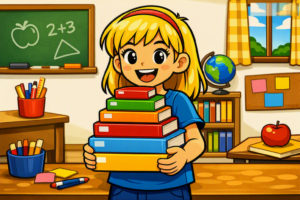
The single most high-leverage organizational decision you will make for your child is choosing a color-coding system early and keeping it consistent. Here’s the subject-color framework built into the SONS notebook system:
Red– English / Reading / Language Arts
Green– Science
Orange– History / Social Studies
Cyan / Blue– Math
Yellow– Language
Assign these colors in elementary school and never change them. By middle school, the association is automatic, your child’s brain already knows that green means Science without having to think about it. By high school, this shortcut is so deeply ingrained that the system runs itself.

At this stage, the goal is not efficiency, it’s familiarity. Young children are learning that materials have a home, that colors mean something, and that the routine of organization exists. Keep everything extremely simple.
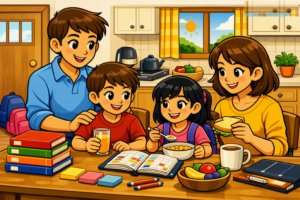
Every night, spend five minutes together going through the backpack. Pull everything out. Put papers in the right folders. Repack. This brief ritual does more for a child’s organizational development than any single supply purchase.
💡 Model the routine: Do a “backpack check” together each night. Instead of “clean your backpack,” say “Let’s find your reading folder and put your homework inside.” Break it into small, specific steps and do it alongside them, not just for them.
By third grade, the system has been running for a couple of years. Now it’s time to expand it and begin transferring ownership to the student.
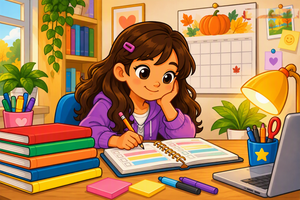
The single most important addition in upper elementary is the daily planner. Introduce it with one simple rule: every assignment gets written down before leaving school. Not at home, not from memory- at school, as soon as it’s assigned. This habit, built consistently from 4th grade forward, pays dividends for the rest of a student’s academic career.
Add a weekly “binder clean-out” – 10 minutes on Sunday evening or Friday afternoon. Together, file completed work, discard irrelevant papers, and make sure every divider section is in order. This weekly reset prevents the slow accumulation of chaos that derails most middle school transitions.

Middle school is where organizational systems either hold or collapse. Students suddenly have five or six different teachers, a locker to manage, a rotating schedule, and exponentially more homework. The students who navigate this transition well are almost always the ones who arrived with an established system.
Middle school is a time of growing independence and responsibility. Students are expected to manage multiple classes, assignments, and extracurricular activities. When students have a reliable system for organizing binders and notebooks, they are less likely to miss deadlines, lose important work, or feel overwhelmed by school demands.
At this stage, the parent’s role shifts from doing to coaching. Instead of doing the weekly clean-out together, ask about it. Instead of checking the planner, ask your student to show you what’s due this week. The goal is to make the student the expert in their own system – with you available as a resource, not a manager.

By high school, a student who has been working within a consistent organization system since elementary school should be able to manage almost entirely independently. The parent’s role is primarily supportive – available for problem-solving, not driving the daily operation of the system.
High school is also when digital tools start playing a meaningful role. Google Calendar or a school-provided LMS can supplement the physical planner but should not replace it. Research consistently shows that writing things down by hand supports memory consolidation in a way that typing does not. The physical planner remains the anchor; digital tools are reinforcements.
No matter what grade your child is in, the most important maintenance habit is the weekly reset – a dedicated 10–15 minutes to:
1 Empty and sort the backpack – everything out, papers sorted, trash discarded
2 File completed work in the correct subject section of the binder or notebook
3 Discard outdated papers – permission slips from last month, old quiz drafts
4 Review the planner for the upcoming week – what’s due, what’s coming, what needs prep
5 Repack with everything needed for Monday morning
Done consistently across 13 years of school, the weekly reset prevents small disorganization from compounding into the kind of systemic chaos that affects grades, confidence, and morning stress levels.
If your child is already in fourth grade or eighth grade with no organization system in place, a system can be introduced at any point. Here’s how to do it without creating resistance:
A K–12 student organization system is not a set of supplies. It is a set of habits, reinforced by consistent tools, built gradually over 13 years, and calibrated to the right level of parent involvement at each stage.
The students who arrive at high school able to manage a demanding workload without falling apart are the ones who built the foundation early. They know which color is which subject. They write things down. They reset every week. And because those habits are automatic, not effortful, they have cognitive bandwidth left over for the things that actually matter: engaging with ideas, solving hard problems, and building a real understanding of the subjects they study.
The SONS color-coded notebook system gives students one consistent color per subject – from their first day of elementary school through graduation day. Explore the SONS System →