


By now, most parents have heard about the “summer slide”, the academic backslide that happens when school structure disappears for ten weeks straight. What’s talked about far less is one of the simplest, most research-backed tools for fighting it: color.
It sounds almost too simple to work. But color-coding isn’t a parenting trend, it’s a cognitive strategy backed by real studies on memory, attention, and retrieval.
This isn’t a marketing claim, it’s backed by neuroscience and psychology research spanning more than a decade.
A 2024 study published on color-coding in introductory physics found that strategically using color helps students understand and connect complex ideas across diagrams, equations, and definitions, by linking different representations and making it easier to identify patterns, track information, and separate complex details.
The effect isn’t limited to physics or even to older students. Research on color coding in programming education found that a color-coded design was more beneficial than a grayscale design, students using color-coded materials showed shorter fixation duration, lower cognitive load, and better learning performance than those using plain black and white materials.
🧠 Color does not just decorate information — it helps organize it in memory, giving the brain additional retrieval cues that make recall easier and more reliable.
In plain terms: when your brain sees a color repeatedly attached to the same subject, it builds a shortcut. Red always means English. Green always means Science. Over time, your child doesn’t have to think about which notebook is which their brain already knows, the same way you instantly recognize a stop sign by its shape and color before you even read the word “STOP.”

During the school year, a child’s brain gets constant external structure, bells ringing, schedules posted, teachers reminding them what subject comes next. Summer removes nearly all of that scaffolding at once.
This is where color-coding becomes especially powerful: it acts as a retrieval cue. Retrieval cues are stimuli that help trigger the recall of information from memory, and when retrieval cues match the original learning context, memory performance improves, because environmental cues can trigger related memories.
Translated to summer learning: if your child studied math all year using a blue notebook, seeing that same blue notebook in July,, even just to do a few practice problems, can help reactivate the mental “folder” where all that math knowledge lives. The color itself becomes a bridge between the school year that just ended and the one that’s coming.
This matters because visual cues activate specific pathways in the brain involved in visual processing and memory formation, and humans process visual information dramatically faster than text, making color one of the fastest, lowest-effort tools available for keeping a subject “warm” in a child’s memory over a long break.
One of the most consistent findings across color-coding research is its effect on cognitive load, essentially, how hard the brain has to work to process information.
Color-coding learning materials by subject or theme gives the brain additional retrieval cues, making information easier to organize and recall. Researchers across multiple studies have found that color-coding lessens cognitive burden because learners can assign significance to color almost instantly, without having to consciously decode it.
This matters enormously in summer, when a child’s motivation and focus are naturally lower than during the school year. A system that requires less mental effort to use is a system that’s actually going to get used. If your child has to stop and think “wait, which notebook was this again?” every time they sit down, the friction adds up and friction is often the difference between a habit that sticks and one that quietly disappears by week two of summer break.
A simple, color-coded system removes that friction almost entirely.
You don’t need a complicated setup, in fact, simpler is better. Experts recommend a limited, cohesive palette of around 5 to 9 colors, since too many colors can overwhelm working memory rather than help it.
Pick a color for each subject your child is working on this summer and keep that color the same all season. Consistency is what builds the mental shortcut. If red means reading in June, it should still mean reading in August.
The color system shouldn’t live only in one notebook. Apply it to folders, index cards, a summer calendar, even a sticky note system on the fridge. The more consistently the color shows up, the stronger the retrieval cue becomes.
A simple color-coded chart on the wall or refrigerator, showing which color belongs to which subject, gives your child (and you) a quick reference point. This single visual anchor does a lot of heavy lifting for very little effort.
A dedicated, color-coded notebook for each subject gives the whole system a physical home. This is exactly the thinking behind the SONS color-coded notebook system, each subject gets its own color, all year round.
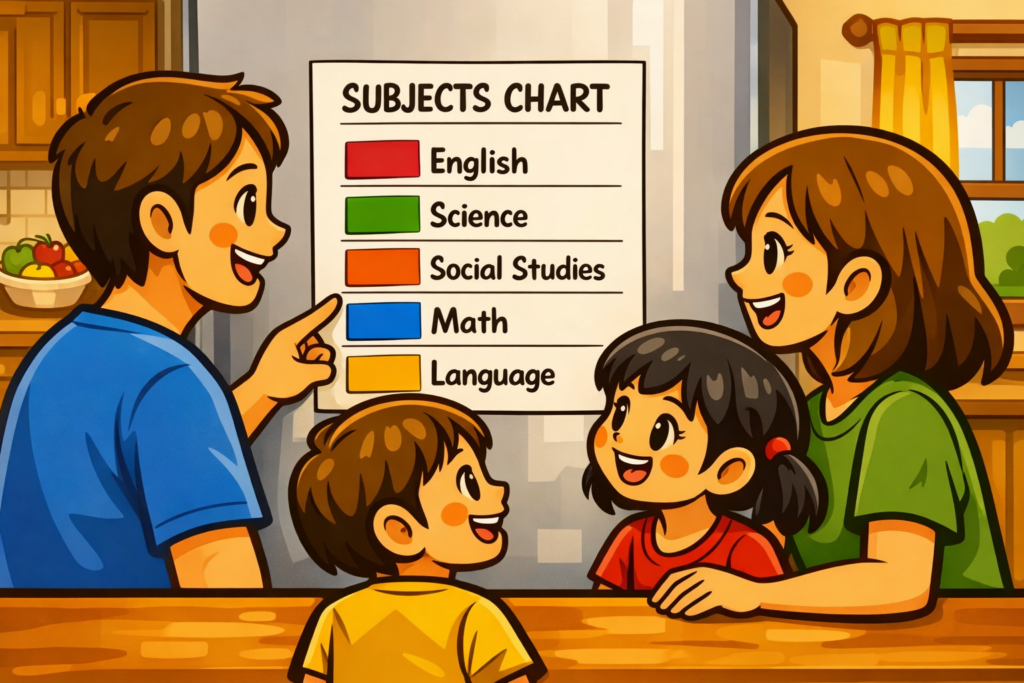
If you want a starting point rather than building one from scratch, here’s a simple five-color framework that maps well onto most core subjects:
Red — Reading / English
Green — Science
Orange — Social Studies / History
Cyan / Blue — Math
Yellow — Language / Vocabulary
This is the exact structure behind the SONS notebook system — five clear, consistent colors that travel with your child from the classroom in May to the kitchen table in July, and right back into the classroom in September.
Color-coding isn’t a magic fix for summer learning loss, but it is one of the lowest-effort, highest-leverage tools available to parents. It taps directly into how the brain naturally organizes and retrieves information, reduces the mental effort required to stay consistent, and gives kids an external structure to lean on when the external structure of school disappears for ten weeks.
Best of all, it costs almost nothing to start. Pick five colors. Assign them to subjects. Keep them consistent. That’s it. The brain does the rest.
Explore the SONS color-coded notebook system — the same five-color structure that keeps kids organized from September through summer and back again. Explore the SONS System →